
Medically reviewed by our in-house trichology committee.
Something changed in the last few years, and it changed quietly. Finasteride used to mean a dermatology appointment, a conversation, and a printed prescription. Now a subscription site can hand it to you after a four-minute questionnaire and a photo of your hairline, delivered monthly, cancel anytime.
That convenience is real, and for plenty of men it removed a barrier that was mostly friction. But it also removed the part of the process where somebody asks about your mood history, warns you about a specific blood test, and tells you what to do if something feels off. This article puts that part back. It is not here to talk you into the drug or out of it — only to hand you the same two documents your prescriber is working from.
The prescription you can get in four minutes
Start with the biology, because it is short. Testosterone converts into dihydrotestosterone — DHT — through an enzyme called 5-alpha-reductase. On a genetically susceptible scalp, DHT shortens each growth cycle and shrinks the follicle a little further every time around. Finasteride blocks one form of that enzyme, the type II, and DHT levels fall.
It is the only oral treatment for male pattern hair loss with an approval file built on placebo-controlled trials. That fact does most of the work in any comparison you will read online, and it explains something more practical: every product marketed as a “natural DHT blocker” is playing in a different league, with a different burden of proof. Does Saw Palmetto Work for Hair Loss? The Honest Numbers puts a measured figure on that gap, and the gap is roughly double.
What the telehealth form compresses is not the biology. It is the judgment. A prescriber who has your history in front of them is weighing how fast your hairline is moving, what else you take, whether you have ever been treated for depression, and when you might next need a PSA test. A form optimized for conversion is weighing none of that particularly hard.
💡 Thomas R.’s take: “The question men ask me most is not ‘does it work.’ It is ‘am I going to regret this.’ Those are two different questions with two different documents behind them, and mixing them is how people end up either scared of a drug that would have helped or blindsided by something they were never told. The trials answer the first. The label answers the second.”
One practical note before the evidence, because it heads off a common misunderstanding: while the prescription question gets settled properly, the shelf still has a few things that need no prescriber at all. An antifungal shampoo is the most documented of them — modest, cheap, and completely unrelated to the hormonal pathway.
Ketoconazole 2% Shampoo
A scalp antifungal with a modest reported effect on density · Not a substitute for a systemic treatment or a consultation · Contact time matters more than the brand
- Available over the counter, unlike the tablet this article is about
- Targets scalp inflammation and flaking, not the hormonal pathway
- Two or three washes a week, alternating with a gentle shampoo
- Worth mentioning at your appointment, like anything else you use
from $15
See on AmazonAffiliate link
What the trials actually counted
The pivotal work appeared in the Journal of the American Academy of Dermatology in 1998, run by the Finasteride Male Pattern Hair Loss Study Group. Men with androgenetic alopecia, two years, drug against placebo.
The headline number is genuine: hair counts rose by roughly 107 hairs at one year and 138 at two years compared with placebo. Participant self-assessment, investigator assessment and an independent panel reviewing photographs all pointed the same way.
Now read that number the way a trialist reads it, because this is where popular write-ups mislead without lying. Those hairs were not counted across your whole head. They were counted inside a small fixed target zone at the crown, revisited at every appointment, because counting an entire scalp is not feasible. So the figure describes local density in one marked patch. A man who reads “+138 hairs” and pictures a restored hairline is setting himself up; a man who reads “miniaturization went backwards where it had been going forwards” has understood the finding.
Twelve years later, a systematic review in the Archives of Dermatology pooled twelve trials and 3,927 men to answer the only question that survives marketing: taken together, what holds up?
Its conclusion is worth quoting for its shape as much as its content. Moderate-quality evidence indicates that daily oral finasteride increases hair count and improves both patient and investigator assessment of hair appearance — while increasing the risk of sexual dysfunction. Improvement was reported by substantially more men on the drug than on placebo, in the short term and in the long term alike.
Notice that the authors did not write “effective and well tolerated,” and they did not write “dangerous.” They wrote both halves in one sentence, because that is the shape of the file. Anyone who keeps only one half has made your decision for you.
The 2012 revision, and one careful phrase
On April 11, 2012, the FDA required labeling changes for finasteride, and the changes are specific enough to be worth knowing by heart.
The 1 mg label was revised to include libido disorders, ejaculation disorders and orgasm disorders that continued after the drug was stopped. Both the 1 mg and 5 mg labels also gained a description of reports of male infertility or poor semen quality, described as improving or normalizing after discontinuation.
The trigger was an analysis of post-marketing reports submitted between 1998 and 2011. And the agency attached a qualification that has to travel with the rest of the sentence or the sentence becomes propaganda: a causal link has not been established. The reports suggest a wider range of effects than previously described; they do not demonstrate that the drug produced them.
Holding both ends of that is the whole skill here.
A spontaneous report is not evidence in the way a trial is. Nobody randomized anything, nobody verified most of it, and people who feel terrible report far more often than people who feel fine. A man going through a hard stretch who swallows a tablet every morning will reasonably suspect the tablet. That limitation is real and it is not a dismissal.
The reverse is equally true, and it is what the reassuring camp keeps skipping. “Not established” does not mean “does not happen.” It means the available tool cannot settle it — and the regulator considered the signal serious enough to change a label, which is not a thing agencies do casually. Europe went further thirteen years later.
So the defensible position is an uncomfortable one, and it fits in two sentences. These effects affect a minority of men. They are also not an invention of the internet.
Which is exactly why this belongs with a clinician who can reassess it with you over time. A prescribed treatment gets judged, adjusted and stopped in a consultation — never alone, never by comparison with a stranger’s story whose full history you will never know.
What Europe put in the box in 2025
Here is the most recent development, and it has barely crossed the Atlantic in coverage.
The European Medicines Agency ran a Union-wide review of finasteride- and dutasteride-containing medicines. Its safety committee, the PRAC, confirmed suicidal ideation as a side effect of finasteride tablets, at both 1 mg and 5 mg. No direct link was retained for dutasteride. On June 19, 2025, the European coordination group endorsed the resulting measures.
Two of them are physical, and an American reader will not find them in their own packaging.
The first is a patient card placed inside packs of finasteride 1 mg, restating the risk and the action to take. Patient cards are normally reserved for medicines under reinforced surveillance; the decision to add one is itself a statement.
The second is a new line in the patient information telling people to seek medical advice if they run into problems with sexual function — reduced sex drive, erectile difficulty — on the explicit grounds that these known effects may contribute to mood changes. The connection between the two is no longer left for each patient to work out privately.
And one phrase from that review deserves repeating exactly: the frequency of this effect is unknown, because the available data do not allow it to be estimated. Not rare, not common. Unmeasured. That is unsatisfying, and it is more honest than the invented percentages circulating in its place.
The overall verdict has to be reported with the same care: European regulators concluded that the benefit-risk balance remains favorable across the approved uses. They did not withdraw anything. They required that it be prescribed knowingly and taken knowingly.
What to do about it is not mine to decide. A mood that darkens, intrusive dark thoughts, or a depressive state emerging on treatment warrant medical advice without waiting for the next scheduled visit. This is not a side effect to sit with and see whether it passes. If those thoughts become overwhelming, emergency care comes before every other consideration in this article, hair included.
For women, it is a different question
This needs its own section, because carrying the section above across to female hair loss would be the most damaging error possible here.
The absolute point first. Finasteride is contraindicated in women who are or may potentially be pregnant, because of the risk to a male fetus. The label goes past swallowing the tablet: a woman who is or could be pregnant should not handle crushed or broken tablets, since finasteride may then be absorbed. Intact tablets are coated and prevent contact during normal handling. If contact with a crushed tablet occurs, the area should be washed immediately with soap and water.
That is not defensive legal drafting. It is the reason a pack does not get shared inside a couple, does not get loaned, and does not sit open in a bathroom used by someone who might be pregnant.
On effectiveness, the data are disappointing and worth knowing before anyone spends a year on it. The Cochrane review of treatments for female pattern hair loss pooled three trials comparing finasteride 1 mg with placebo in women: 30 of 67 participants improved on the drug, against 33 of 70 on placebo. No difference, on evidence the authors themselves grade as low quality.
None of which means nothing exists for female hair loss — only that the answer lives elsewhere, in bloodwork, hormonal status and topicals, which Menopause Hair Loss Treatment: Natural Protocol for Women Over 50 works through in detail.
Four questions before you fill the form
Nothing above tells you what applies to your situation. The same drug can be a reasonable option, the wrong target entirely, or a decision that needs real discussion, depending on the pattern of your loss, your history and your plans. Four questions sort out what belongs on the table at your appointment — and what you should not be deciding alone.
Before the appointment · 4 questions
What belongs on the table?
Question 1 / 4
Who are you, and what does your hair loss look like?
💡 Preparation grid built by Thomas R., hair restoration specialist, from the trials and regulatory decisions cited at the end of this article. It prepares a consultation: it does not diagnose, does not prescribe, and replaces no medical advice.
What to bring to the appointment
A fifteen-minute visit is mostly won before you walk in. Four things are worth preparing, and they cost about a quarter of an hour.
Dated photos. Same spot, same light, same framing, front and top. In six months this is the only measurement you will have, and memory will not substitute for it. Without a baseline, no later assessment means much.
An honest timeline. When the hairline started moving, how quickly, who is thinning in the family and on which side. Rate of change carries as much weight in the decision as the current state does.
Everything you take. Supplements included, especially anything sold as a DHT blocker. They belong in the conversation even though nobody prescribed them.
Your mood history, said out loud. A past depressive episode, a treated anxiety disorder, a rough patch currently under way: since the 2025 European decision this is safety information, not an optional confidence. It changes how follow-up gets arranged.
One more item for men past forty. This drug lowers PSA. In trials among men aged 18 to 41, the mean value fell from about 0.7 to 0.5 ng/mL over twelve months. A PSA drawn without the lab or the physician knowing you take it will be read wrong. And the converse matters more: any confirmed rise in PSA while on treatment should be evaluated, even when the number still looks normal.
Limits and when to see someone
This article describes a medication, it does not prescribe one, and it replaces neither a diagnosis nor medical advice. Three limits, stated plainly.
It treats one kind of hair loss. Androgenetic alopecia, telogen effluvium, alopecia areata and iron deficiency look similar from across a room and are managed in entirely unrelated ways. A 5-alpha-reductase inhibitor does nothing for the last three. Recognizing the pattern comes first, and Balding in Your 20s: 5 Early Signs & How to Stop It lays out the markers that sort it.
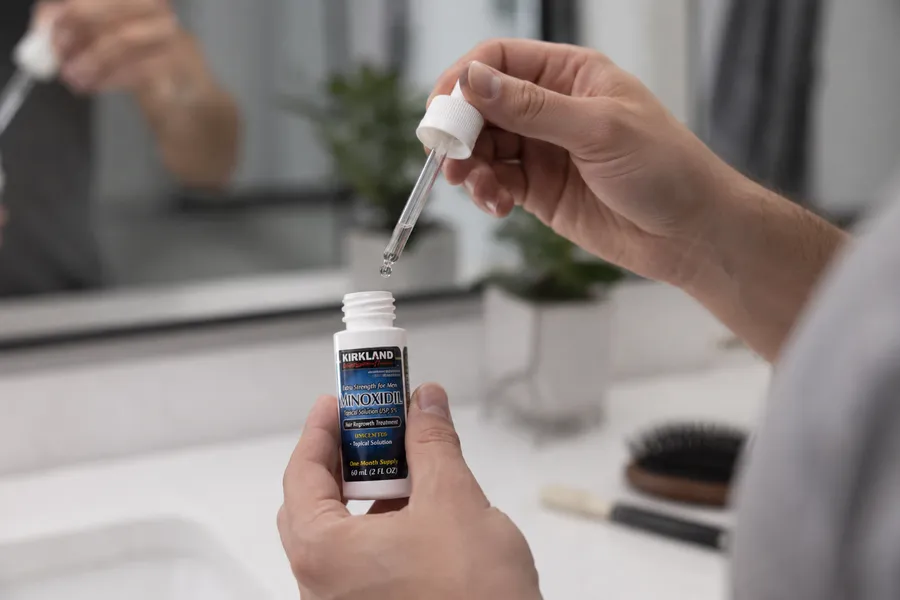
It does not compete with a topical on a “which is better” axis. They work in different places: one lowers DHT, the other extends the growth phase. Combining them is common and gets discussed in consultation, including the initial shedding phase the topical imposes, covered in Minoxidil 5% for Men: Protocol, Results & Shedding Phase Explained.
Some signs need prompt attention: sudden heavy shedding, sharply defined bald patches, a red or painful scalp, or accompanying symptoms such as unusual fatigue or weight change. No long-term treatment decision should be used to make those wait.
Frequently asked questions
Does finasteride regrow hair, or only stop the loss?
Both were measured in the pivotal trial: an increase in hair count within the counted zone, and slowed progression. The observed effect favors the crown over the frontal hairline, and it is a local density gain rather than a reconstruction.
What happens if I stop?
The benefit fades, because the mechanism stops when the tablet does. That is not peculiar to this drug — most treatments for pattern hair loss work for as long as they are used. Any change is a decision for the prescriber, not a solo experiment.
Can it be combined with a topical?
Frequently, and coherently, since the pathways differ. It belongs in the consultation. One methodological tip: starting two new things in the same month makes the six-month assessment meaningless.
How common are sexual side effects?
The systematic review concluded that the risk is increased, without a single percentage that can honestly be presented as the answer — it moves depending on the trial and on how the question was asked. What is established is that the risk is real, that it affects a minority, and that it is worth raising before rather than after.
What about effects that persist after stopping?
Cases have been reported and have appeared on the US label since 2012, carrying the explicit note that causality is not established. Neither proof nor fiction: a signal regulators took seriously, on data that cannot quantify it.
Can a woman take it for hair loss?
It is contraindicated in pregnancy or possible pregnancy, and the pooled trials showed no difference from placebo in women. Any prescribing outside that picture is a specialist decision, not something an article should settle.
Is there a topical version?
Topical formulations exist and are being studied, but their regulatory status, availability and evidence base differ sharply from country to country. It is not a way around the prescription, and it is a question for the physician like everything else here.
Sources and references
- Kaufman KD, Olsen EA, Whiting D, Savin R, DeVillez R, Bergfeld W, Price VH, Van Neste D, Roberts JL, Hordinsky M, Shapiro J, et al. — Finasteride in the treatment of men with androgenetic alopecia. Finasteride Male Pattern Hair Loss Study Group. Journal of the American Academy of Dermatology, 1998;39(4 Pt 1):578–589. (PMID 9777765)
- Mella JM, Perret MC, Manzotti M, Catalano HN, Guyatt G. — Efficacy and safety of finasteride therapy for androgenetic alopecia: a systematic review. Archives of Dermatology, 2010;146(10):1141–1150. (PMID 20956649)
- U.S. Food and Drug Administration — PROPECIA (finasteride) tablets, prescribing information, accessdata.fda.gov: contraindication in women who are or may become pregnant, handling of crushed or broken tablets, effect on PSA, and the April 2012 labeling revision covering sexual adverse events reported after discontinuation.
- European Medicines Agency (EMA) — Finasteride- and dutasteride-containing medicinal products, Article 31 referral: PRAC conclusions on suicidal ideation and the measures endorsed by the CMDh on 19 June 2025 (patient card for finasteride 1 mg, patient information on sexual function).
- van Zuuren EJ, Fedorowicz Z, Schoones J. — Interventions for female pattern hair loss. Cochrane Database of Systematic Reviews, 2016;(5):CD007628.