Medically reviewed by our in-house trichology committee.
Most people meet these two names within about a minute of each other. You search for something that slows hair loss, minoxidil comes up everywhere, and then a serum appears in the results with a word on it that looks like a typo of the first one: aminexil. Same kind of promise, similar price bracket, no obvious way to tell them apart.
So the question arrives fully formed: which one works better?
It’s a fair question asked from the wrong end. These aren’t two brands competing in one aisle. They belong to two different legal categories, and that difference decides everything downstream — including how much proof you are entitled to demand before you hand over your card.
Two names, one letter apart — and two very different histories
The confusion is earned, because the two molecules really are related.
Minoxidil started life as an oral blood-pressure drug. Hair growth turned up as a side effect, got noticed, and was eventually developed on purpose as a topical. That path is ordinary in pharmacology: you find something you weren’t looking for, you study it, and you end up filing a dossier.
Aminexil came out of a cosmetics lab instead. Its chemical name is 2,4-diaminopyrimidine 3-oxide; on an ingredient list you’ll see it as Diaminopyrimidine Oxide. The US patent covering these derivatives and their use against hair loss was filed by L’Oréal in 1989 and granted in 1990. So the structural kinship with minoxidil isn’t a rumour someone started on a forum — it’s written into the patent title.
But chemical kinship is not equivalence of effect. Two neighbouring molecules can behave very differently on skin, and more importantly, they can take opposite regulatory roads. That is exactly what happened. Topical minoxidil went toward drug status. Aminexil stayed a cosmetic ingredient.
Hold on to that fork in the road. Everything else follows from it.
💡 Thomas R.’s take: “People ask me which of the two molecules is stronger. I don’t know, and nobody knows, because the head-to-head comparison has never been run under conditions that would settle it. What I do know is which of the two had to submit to an examination before it reached the shelf. That’s a different question — but it’s the one that protects you.”
Read the label a drug is forced to print
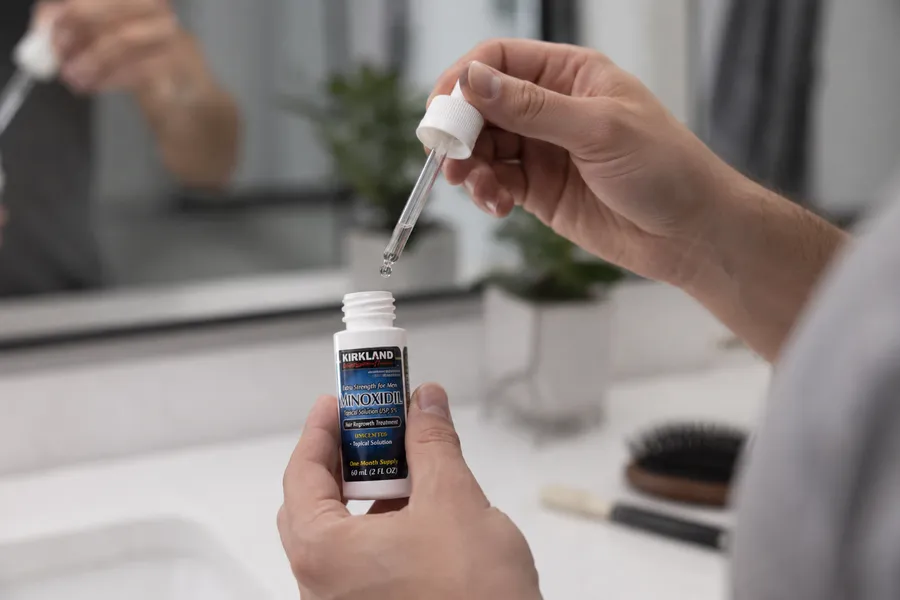
Here is a step I recommend to everyone stuck between these two bottles, and it costs nothing: read minoxidil’s Drug Facts panel. Not the ad. The panel.
You’ll find, printed by the manufacturer, the admission an ad never makes. The label for a 5% topical minoxidil solution states that the product is for the top of the scalp — the vertex — and not for a receding hairline or frontal baldness. It says results may take months. And it carries a sentence worth the whole panel: this product will not work for all men.
Sit with what that means. A drug manufacturer is required to publish the limits of its own product: where it doesn’t act, how long it takes, the fact that it may simply fail, and the list of its adverse effects. That requirement isn’t a weakness in minoxidil. It’s the visible trace of a file that was examined by someone other than its author.
Now pick up the cosmetic serum sitting next to it in your cart. Look for the equivalent: the area where it doesn’t work, the share of people it fails, the point at which you should give up. You won’t find it. Not because the product is dishonest, but because nothing obliges it to publish that.
That’s the single most useful difference between these two bottles, and it’s the one nobody explains.
Aminexil Hair Serum — Ampoule Course
Aminexil's usual format: a leave-on scalp application · Still a cosmetic, with a far thinner clinical file than minoxidil's · Replaces neither a diagnosis nor a treatment already underway
- Tolerance is its strongest single argument
- Mechanism documented by its patent holder, clinical evidence weak
- Applied to a dry or towel-dried scalp
- No treatment claim: this is a cosmetic
from $26
View on AmazonAffiliate link
What aminexil claims to do, and what that’s worth
The mechanism proposed for aminexil is genuinely interesting, and it deserves explaining rather than dismissing.
A sheath of connective tissue surrounds the root of each hair. Over time, on a scalp losing hair in a pattern, that perifollicular tissue tends to stiffen — a fibrotic change described in histology for decades. Aminexil’s premise is to work against that hardening: by slowing an enzyme involved in collagen cross-linking, lysyl hydroxylase, the molecule is meant to keep the sheath supple and preserve the hair’s anchorage for longer.
Coherent, publishable, and it proves nothing about your head. A mechanism is a hypothesis about how. It does not stand in for a demonstration of how much — and that is where aminexil’s file thins out fast.
The available clinical literature carries one flaw almost everywhere: aminexil is nearly always studied inside formulas containing other things. Lotions pairing a diaminopyrimidine oxide derivative with adenosine, peptides, biotin, plant extracts. That work exists, it reports improvements, and it is largely open-label, without a placebo arm, in small groups. When a seven-active product produces a result, you cannot say which of the seven produced it — or how much of it was the participant’s own expectation.
The 2020 review in Natural Products and Bioprospecting, which surveys marketed topical formulations for androgenetic alopecia, places aminexil accurately in that landscape: present on the market, structurally related to minoxidil, and without the body of controlled trials that accompanies it.
There are also trials in the Cochrane CENTRAL register comparing an aminexil-plus-minoxidil combination against minoxidil alone in men. Their existence is verifiable; their number is small, and their weight does not currently support quoting a figure. I’d rather say it that way than cite a percentage I couldn’t defend.
What a cosmetic is allowed not to tell you
This needs precision, because the nuance gets lost in both directions: the cosmetic frame is neither a legal void nor an efficacy review.
In the United States, the line is drawn by intended use. A product marketed as treating hair loss is, by that claim, a drug — and drugs go through premarket review. A cosmetic doesn’t. It has to be safe and honestly labelled; it does not have to demonstrate that it works before going on sale. In Europe, where aminexil products largely come from, a 2013 regulation on common criteria for cosmetic claims goes a step further: every claim a cosmetic makes, explicit or implied, must rest on adequate and verifiable evidence reflecting current practice.
So a cosmetic brand does have to be able to justify its sentence if challenged. That’s not nothing. But notice what neither frame requires. Neither demands a randomised placebo-controlled trial. Neither demands publishing the file. Neither demands comparison against anything else. And neither obliges anyone to state the proportion of users for whom the product does nothing.
The control exists, in other words, but it fires afterwards, on challenge. A drug’s control fires before market, and it lands on efficacy itself. Those are two levels of demand, not two styles of writing.
It’s also why every anti-shedding cosmetic reads the same careful way: “helps,” “supports,” “reduces the appearance of,” “hair looks.” Those verbs aren’t marketing timidity. They’re a direct consequence of the product’s status. The same logic governs caffeine shampoos, where a UK regulator struck down a claim in 2018 after going through the manufacturer’s file.
Comparing two very unequal files
With the frame in place, the comparison becomes possible — as long as you accept that it’s lopsided.
On minoxidil’s side sits a body of randomised placebo-controlled trials. Olsen and colleagues, publishing in the Journal of the American Academy of Dermatology in 2002, compared 5%, 2% and placebo in men with androgenetic alopecia. That kind of work was later pooled: Adil and Godwin’s 2017 meta-analysis in the same journal, and Gupta and colleagues’ network meta-analysis in the JEADV in 2018, both place topical minoxidil among the non-surgical options with established efficacy against placebo.
On aminexil’s side, there is nothing of that order. No meta-analysis. No randomised placebo-controlled trial on the isolated molecule. A mechanism documented by its patent holder, multi-active formulas assessed open-label, and a handful of registered combination trials.
That imbalance licenses exactly one conclusion: if what you want is density back, only one of the two has shown it can deliver that. It isn’t a moral verdict on aminexil. It’s the state of the files.
That said, almost nobody’s real question is “which is more powerful in the abstract.” It’s which is right for me, given what I’m actually willing to do. And there, minoxidil loses points that appear in no meta-analysis. It’s a drug, with real adverse effects, an early shedding phase that discourages a great many people, an application to sustain indefinitely, and one feature worth knowing before you start: stop, and the benefit fades. Plenty of people quit — and an abandoned treatment is worth zero, whatever its evidence grade.
That gap is precisely where aminexil earns its place: for someone who has ruled the drug out, knowingly, and wants a well-tolerated habit rather than a regrowth promise.
Quick test: aminexil, minoxidil, or neither?
Three questions. Of the five outcomes, two point to a product and three send you elsewhere — which is roughly the split I see in real life.
Selector · 3 questions
Aminexil, minoxidil, or neither?
Question 1 / 3
What are you actually looking at?
💡 Framework built by Thomas R., hair restoration specialist. It places two product categories against each other; it diagnoses nothing and prescribes nothing. Minoxidil is a drug — being able to buy it off a shelf doesn't make the choice, the strength or the follow-up any less medical.
Three reflexes for reading any hair-loss label
What you’ve just read outranks these two molecules. The category holds dozens more, and it will produce dozens after that. Three reflexes are enough to sort them, and they take ten seconds in front of a shelf.
First: find the status before you read the name. Drug or cosmetic? The answer is always somewhere — a Drug Facts panel, an approval reference, the grammar of the claims themselves. It tells you immediately what level of proof was demanded before this thing was allowed to be sold.
Second: ask what the study was actually on. The molecule alone, or a formula containing seven? People, or follicles in a dish? Against placebo, or against nothing? A study of “90 satisfied volunteers” with no control group doesn’t measure the product. It measures expectation.
Third: look for what the manufacturer concedes. A solid file always contains limits — a zone where it fails, a timeline, a failure rate. A product that concedes nothing hasn’t necessarily lied. It has simply never had to answer to anyone.
Aminexil Hair Serum — As an Add-On
Worth considering as a comfortable addition to an existing routine, never as a swap · Any change to a treatment already underway belongs to the clinician who started it
- Never swap an ongoing treatment for a cosmetic
- Watch tolerance when two topicals stack
- Adherence matters more than the number of bottles
- Judge at three months on photos, not in the mirror
from $26
View on AmazonAffiliate link
Limits, precautions, and when to see a doctor
Two reminders, one per product, and neither is negotiable.
Minoxidil is a drug. It has adverse effects — scalp irritation, dryness, unwanted hair elsewhere if the product travels — and an early shedding phase that blindsides anyone who wasn’t warned. Its strength, its format and its follow-up are worth discussing with a clinician or a pharmacist, even though nothing stops you buying it off a shelf. And its benefit depends on continuing: it’s a commitment, not a purchase.
Finasteride, which always shows up in the same conversation, is prescription-only, carries adverse effects worth understanding, and is absolutely contraindicated in pregnancy. It isn’t ordered off a random site and it isn’t shared between friends.
Aminexil is a cosmetic, generally well tolerated, and that tolerance is its real asset. Its risk isn’t dermatological — it’s strategic. It’s the time you hand it while patterned loss carries on. Pregnancy, breastfeeding, ongoing dermatological treatment, broken skin on the scalp: ask before you buy, not after.
A few markers that apply to both:
- Neither product makes a diagnosis. Androgenetic alopecia, telogen effluvium, alopecia areata and iron deficiency look alike from across the room and are managed completely differently. Six months of bottle is six months of not knowing which one you have.
- Never swap an ongoing treatment for a cosmetic, and don’t stack two applications without raising it with whoever is following your treatment.
- Judge on photographs — same framing, same light, same distance, three months apart. The morning mirror measures nothing.
Some signs belong to neither bottle and need a prompt opinion: sudden heavy shedding, sharply defined bald patches, a scalp that hurts or stays red, or associated symptoms — unusual fatigue, feeling cold, cycle changes, unexplained weight change. Those point toward alopecia areata, a thyroid disorder, a deficiency or a systemic illness, and they call for a primary care doctor, a dermatologist or an endocrinologist.
Frequently asked questions
Is aminexil the same thing as minoxidil?
No, even though the similar names and bottles make that confusion easy at the counter. They’re two different categories — an over-the-counter drug with a proven clinical file, versus a cosmetic that was never required to meet that bar — and that difference in status, not the name, is what should drive the choice.
Is aminexil just minoxidil under another name?
No. The two are structurally related — L’Oréal’s 1990 patent covers 2,4-diaminopyrimidine 3-oxide derivatives — but they are distinct substances, with opposite regulatory statuses and different proposed mechanisms. Chemical kinship does not carry evidence across from one molecule to the other.
Can you use both together?
Trials comparing the combination against minoxidil alone are listed in the Cochrane CENTRAL register, but there are few of them and nothing supports quoting a figure. In principle, stacking a cosmetic on an ongoing treatment isn’t absurd; in practice it’s a decision for whoever is following your treatment, and the thing to watch is scalp tolerance.
Can aminexil replace minoxidil?
No data supports saying so, and it’s the wrong framing anyway. An ongoing treatment doesn’t get replaced by a cosmetic on the strength of an article. If minoxidil suits you badly, that’s what to say to a clinician — sometimes the answer is a change of formulation, not a change of category.
Why is aminexil sold in pharmacies if it isn’t a drug?
Because pharmacies sell cosmetics too, and because that distribution channel is a commercial choice rather than a regulatory status. A pharmacy counter is not a proof label. It is, however, a place where you can put a question to someone competent, which is its genuine advantage.
How long before you know whether it’s working?
The hair cycle sets the clock: several months before any change is visible, whatever category the product belongs to. What gets judged is a series of comparable photographs, not an impression. And if you haven’t taken the first photograph, that’s today’s job.
Does the comparison hold for women?
It holds in substance — a product’s status doesn’t change with the user’s sex — but concentrations, indications and precautions differ, and shedding in women deserves a search for the cause first, iron and thyroid at the top of the list. That step comes before choosing a bottle.
Sources and references
-
Philippe M., Sebag H., Hocquaux M., Jacquet B., Laugier J.P. (L’Oréal) — 2,4-diaminopyrimidine 3-oxide derivatives and their use for the treatment and prevention of hair loss — US Patent 4,973,474, granted 27 November 1990. Google Patents
-
Olsen E.A., Dunlap F.E., Funicella T., Koperski J.A., Swinehart J.M., Tschen E.H., Trancik R.J. — A randomized clinical trial of 5% topical minoxidil versus 2% topical minoxidil and placebo in the treatment of androgenetic alopecia in men — Journal of the American Academy of Dermatology, 2002;47(3):377-385. PubMed
-
Adil A., Godwin M. — The effectiveness of treatments for androgenetic alopecia: A systematic review and meta-analysis — Journal of the American Academy of Dermatology, 2017;77(1):136-141. DOI
-
Gupta A.K., Foley K.A. et al. — Efficacy of non-surgical treatments for androgenetic alopecia: a systematic review and network meta-analysis — Journal of the European Academy of Dermatology and Venereology, 2018. DOI
-
Ashique S., Sandhu N.K., Haque S.N., Koley K. — A Systemic Review on Topical Marketed Formulations, Natural Products, and Oral Supplements to Prevent Androgenic Alopecia: A Review — Natural Products and Bioprospecting, 2020;10(6):345-365. DOI
-
Cochrane CENTRAL register — A clinical trial to study the effect of 1.5 % Aminexil and 5 % Minoxidil topical solution vs 5 % Minoxidil topical solution in male pattern hair loss, record CN-01857192. Cochrane Library
-
Drug Facts label for Minoxidil Topical Solution 5%, as published on DailyMed (US National Library of Medicine). DailyMed
-
Commission Regulation (EU) No 655/2013 of 10 July 2013 laying down common criteria for the justification of claims used in relation to cosmetic products — Official Journal of the European Union L 190/31. EUR-Lex
Scientifically validated by our committee of trichology experts. This article does not replace a medical consultation.