Medically reviewed by our internal panel of dermatology experts.
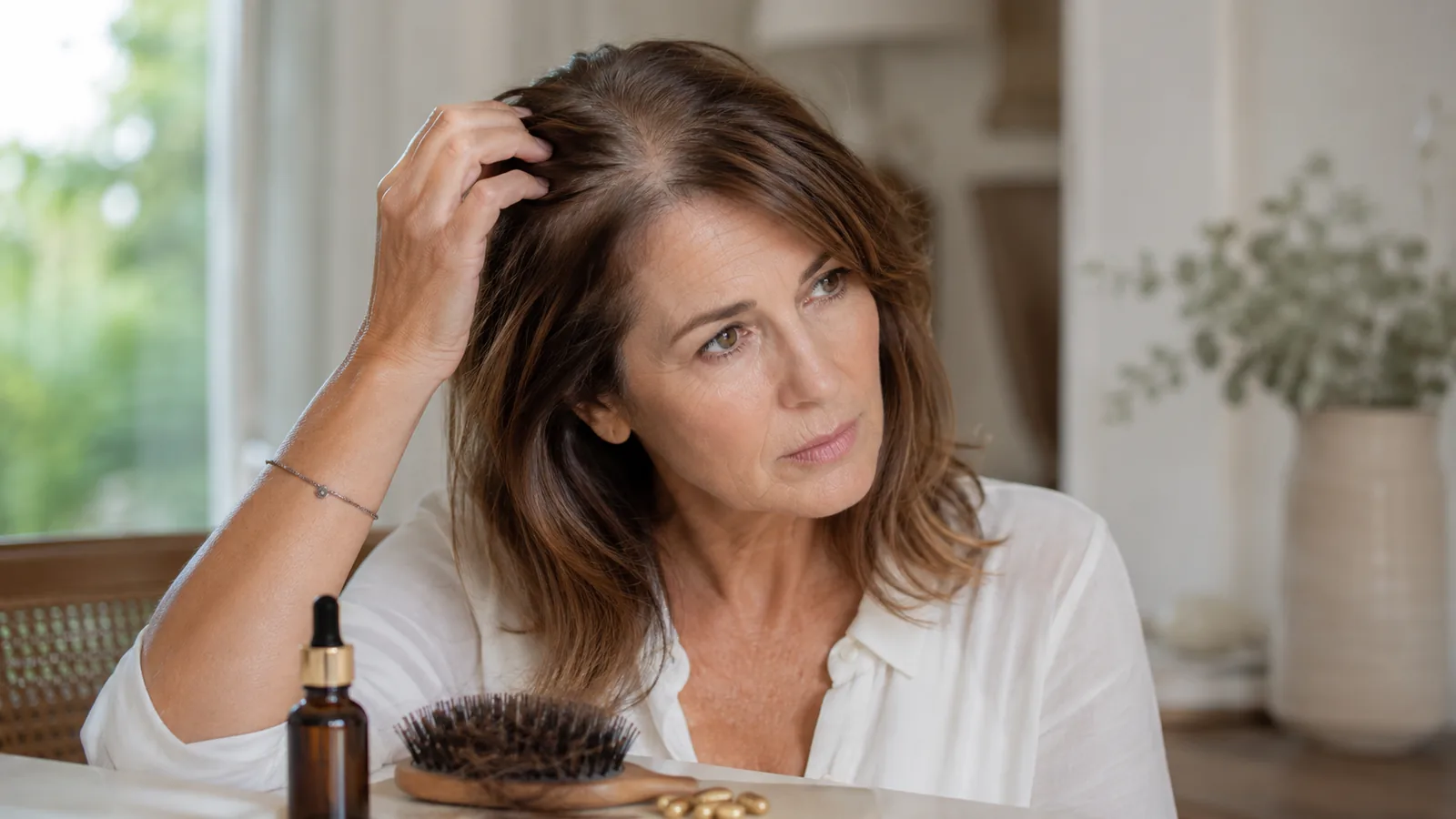
Catherine walked into my office in March 2024 with her scarf tied a bit too high on her head. Fifty-four years old. HR executive. She set her bag on the chair, pulled out her phone, and scrolled through three photos — same position, same lighting, three consecutive years.
“I wasn’t going crazy,” she said. “My doctor told me it was just my age.”
In the photos, her center part was widening year after year. Not abruptly like a postpartum effluvium. Slowly. Relentlessly. With that distinctive contrast of skin beginning to show through where, two summers earlier, there had still been a thick canopy of hair.
This is what nobody had explained to her: menopause hair loss is neither “normal,” nor inevitable, nor a cosmetic detail. It is a precise and well-documented follicular response to the collapse of estrogen. And contrary to what you hear in general consultations, there is a serious protocol to slow it down — sometimes stop it, and in certain cases reverse it.
This guide isn’t a miracle promise. It’s what nine years of follow-up taught me to tell my patients in perimenopause and confirmed menopause. The exact mechanism. The active ingredients that have proven themselves. And the moment to stop tinkering with serums and knock on a dermatologist’s door.
Why menopause attacks your hair — and what it isn’t
The first thing I always make clear to my patients: menopausal hair loss is not the same as postpartum hair loss. Many mainstream articles blur the two. They are radically different hormonal mechanisms — and therefore radically different treatments.
Postpartum is a withdrawal. Menopause is a famine.
At childbirth, estrogen collapses within 48 hours. It’s abrupt, synchronized, terrifying — but it’s a one-time event. The follicle takes a hit, mass-sheds, then rebalances. Six to twelve months and in the vast majority of cases it’s over. If that’s your profile, read our guide on postpartum hair loss instead.
In menopause, the scenario is nothing alike.
Estrogens don’t collapse in two days. They decline in plateaus, sometimes over five to ten years of perimenopause, until reaching a permanent post-menopausal floor. The follicle doesn’t receive a shock — it receives prolonged deprivation. And what happens then is not mass shedding, but a progressive reduction in follicular diameter with each new hair cycle.
This is called androgen-dependent miniaturization. And it’s the core of the menopause problem.
Three simultaneous mechanisms that compound
When my patients ask me “but what is actually happening in my scalp?”, here’s what I describe:
1. Loss of the estrogen shield. Estrogens extend the anagen phase — active hair growth — and increase follicular diameter. Without them, the growth phase shortens. New hairs grow back thinner and shorter than the ones they replace.
2. Unmasking of androgens. Your ovaries continue producing small amounts of testosterone and DHEA-S after menopause. The estrogen/androgen ratio flips. Local 5α-reductase in the scalp converts these androgens into DHT, which then freely attacks sensitive follicles — exactly like male pattern baldness, but in a diffuse thinning pattern. That androgenic component is not unique to menopause either: in a younger woman the same mechanism has a different origin, and you look for it in her cycles — see Does PCOS Cause Hair Loss? What Actually Decides.
3. Low-grade scalp inflammation. The drop in estrogens also reduces collagen and elastin production in the dermis. The scalp becomes more fragile, microcirculation declines, and chronic inflammation sets in — the perfect environment to accelerate miniaturization.
This triple simultaneous attack explains why menopausal hair loss responds far less well to classic anti-shedding protocols than other forms. You cannot treat a famine with a single bandage.
💡 Expert advice from Elena S.: “The first menopausal patient I supported was named Brigitte. She had been using a ‘special anti-hair-loss’ shampoo at $35 a bottle for four years. When we redid her bloodwork together, her free testosterone/estradiol ratio was completely tipped and nobody had bothered to look. The shampoo could do absolutely nothing against the hormonal cause. Wash your hair with whatever you like, but don’t ask a topical product to fix a systemic hormonal shift.”
Which hormonal stage are you in? Quick assessment
Before choosing a protocol, locate yourself. Early perimenopause, late perimenopause, and confirmed menopause don’t require the same priorities — nor the same treatments.
Assessment · 4 questions
Which hormonal stage are you in?
Question 1 / 4
Where are you in your hormonal transition?
💡 Assessment developed by Elena S. from 9 years of follow-up on perimenopause and menopause hair loss.
Whatever your result, remember this: the earlier you act, the more living follicles you preserve. Once miniaturization has been left untreated for over five years, certain follicles enter fibrosis — the irreversible stage where the dermal papilla calcifies and no longer produces hair. That’s exactly what we want to avoid.
The multi-peptide serum: the key to menopausal topical treatment
If I had to keep only one topical active for menopausal hair loss, it would be a well-formulated multi-peptide density serum. Not a volumizing shampoo. Not a biotin lotion. A real serum, with the right molecules, at the right concentration.
Why peptides — and not minoxidil alone
2% minoxidil remains the only topical FDA-approved for female pattern hair loss. But on a menopausal woman’s scalp, it runs into two limits. First, it works on follicular diameter without doing anything for impoverished dermal microcirculation. Second, stopping it triggers an almost immediate return to baseline — lifetime commitment or nothing.
Peptides work differently. GHK-Cu (copper peptide — the tripeptide naturally present in your blood plasma whose concentration crashes after 50) stimulates local production of VEGF, the follicular vascularization factor. It also activates collagen and elastin synthesis in the dermis — exactly what the estrogen drop made you lose. It’s repair biochemistry from below, not surface vasodilation.
We published the complete analysis of The Ordinary’s multi-peptide serum for women who want to understand exactly what they’re applying to their scalp. This serum combines GHK-Cu, Capixyl (acetyl tetrapeptide-3 + red clover extract), caffeine, and REDENSYL — four actives with complementary mechanisms.
Multi-Peptide Hair Density Serum
GHK-Cu + Capixyl + REDENSYL + caffeine · Morning and evening on dry scalp · No rinse · Compatible with minoxidil if applied at a different time of day
- GHK-Cu ≥ 2 mg/mL
- Patented Capixyl (red clover)
- Dermal VEGF activation
- Sensitive scalp friendly
From $34.90
Check on AmazonAffiliate link
The instructions nobody gives
The multi-peptide serum isn’t used like a face serum. Three rules that change everything:
- Dry scalp, never on wet hair — peptides need direct penetration without dilution
- 60-second massage minimum after application, with fingertips, across the crown and center part — this massage also activates microcirculation
- Patience of 4 to 6 months before evaluating the result. Peptides act on the next hair cycle, not on the fiber already grown. No shortcut
💡 Expert advice from Elena S.: “A 58-year-old patient, a former attorney, once told me: ‘I applied the serum every evening for three weeks and stopped because I saw nothing.’ That’s exactly what not to do. The hair follicle works in cycles of 3 to 6 months — you cannot evaluate a biological intervention over 21 days. I tell my patients: take a photo on day 1, put your phone in a drawer, and pull it out again at month 5. That’s when you’ll know.”
And what about rosemary essential oil?
Many of my patients ask whether rosemary essential oil (cineole chemotype) — well-documented by the Panahi 2015 study vs 2% minoxidil — can replace the multi-peptide serum at menopause.
Honest answer: it’s a useful complement, not an equivalent alternative. Rosemary EO is a partial inhibitor of local 5α-reductase. So it acts on the androgenic axis of menopause, which is valuable. But it doesn’t have the vascular and dermal action of copper peptides. The optimal protocol combines both: daily peptides, rosemary diluted twice a week in separate applications. Full details are in our guide on how to thicken fine hair in women.
Rosemary Essential Oil · Cineole Chemotype · Organic
Cineole ≥ 40% · Partial 5α-reductase inhibitor · Must be diluted at 2–3% in a carrier oil (castor, jojoba) · 2 applications per week
- Panahi 2015 study vs minoxidil
- Local anti-DHT action
- Peptide-compatible
- Synergistic with massage
From $10.90
Check on AmazonAffiliate link
Nutrition and supplements: feeding a follicle in famine
At menopause, metabolism slows. Micronutrient needs change. And the hair follicle — one of the most energy-demanding tissues in your body — immediately pays the bill.
Phytoestrogens: the natural option before HRT
Red clover (Trifolium pratense) and soy contain isoflavones — formononetin, biochanin A, genistein, daidzein — that bind partially to beta estrogen receptors. Not with the power of endogenous estrogens. But enough to ease several menopausal symptoms, including part of hair fragility.
The clinical study by Atkinson et al. published in The American Journal of Clinical Nutrition (2004) showed that red clover isoflavone at 40 mg per day for 12 months significantly improved several markers of tissue health in menopausal women, including skin and hair quality.
What phytoestrogens are not: an equivalent replacement for a well-conducted HRT. If your hair loss comes with debilitating hot flashes, severe insomnia, or marked vaginal dryness, HRT belongs on the discussion table with your gynecologist. Phytoestrogens are an interesting option for women in early perimenopause, or those for whom HRT is contraindicated.
Red Clover Phytoestrogens · Standardized
40 mg standardized isoflavones per capsule · 3 to 6 month minimum course · Seek medical advice if history of hormone-dependent cancer
- Atkinson 2004 study
- Bioavailable formononetin
- Menopause-diet compatible
- Take with food
From $24.90
Check on AmazonAffiliate link
The keratin + dextrin complex: feeding the strand from within
This is the nutritional angle systematically neglected. The hair fiber is 95% keratin — a protein rich in cysteine, methionine, and sulfur amino acids. At menopause, intestinal protein absorption decreases, and hepatic keratin synthesis slows with the drop in IGF-1.
A supplement based on hydrolyzed keratin + dextrin (which acts as a carrier to improve bioavailability), combined with zinc bisglycinate, biotin, and selenium, provides the elementary bricks your follicle now struggles to synthesize on its own. It’s not a treatment for the hormonal cause — it’s structural support for hair production while the other actives work on the underlying issue.
💡 Expert advice from Elena S.: “Sylvie, 61, an osteopath, told me a few months ago: ‘Are you going to suggest more capsules?’ I told her no, I wasn’t going to suggest anything at all — I just asked how many eggs, fish, and white meat servings she ate per week. Three years on a ‘light’ menopause diet. Almost zero complete proteins. We fixed the plate first. The keratin supplement came in as backup six weeks later. Visible density at 5 months — without any topical.”
Hydrolyzed Keratin Complex + Dextrin + Zinc
Hydrolyzed keratin 500 mg · Dextrin carrier · Biotin 100 mcg · Zinc bisglycinate 8 mg · Selenium 55 mcg · 3-month minimum course
- Optimized bioavailability
- Menopause-diet compatible
- Structural support
- Visible effect month 3-4
From $32.90
Check on AmazonAffiliate link
Blood markers to absolutely request
Before any serious protocol, demand this panel from your doctor. If you don’t have these dosages, you’re flying blind:
- Ferritin: hair-health optimum > 70 ng/mL. Below 40, your hair loss has a deficiency component independent of menopause
- TSH + free T4 + anti-TPO: thyroiditis is common in perimenopause and its first visible symptom is often hair loss
- FSH + estradiol: to precisely locate your hormonal stage and discuss possible HRT
- Vitamin D (25-OH): optimum > 50 ng/mL. Deficiency is massive after 50 in temperate climates
- Serum zinc: involved in keratinogenesis, frequently low with restrictive menopausal diets
Iron Bisglycinate Complex + Vitamin C
Iron bisglycinate 14 mg + Vitamin C 60 mg + Folates · Digestively well-tolerated · Take only after a ferritin blood test confirms deficiency
- Non-constipating iron
- Optimized absorption
- Medical advice recommended
- 3-month course
From $19.90
Check on AmazonAffiliate link
At night: protect fragile hair
One detail that changes everything over 18 months: the silk pillowcase. Menopausal hair fiber has lost elasticity and hydration. On regular cotton, every night creates micro-tears that visually amplify density loss. Natural silk, smooth and non-absorbent, significantly reduces these traumas — for under $25 and zero contraindications.
Natural Silk Pillowcase · 22 Momme
Grade 6A natural silk · Envelope closure · Reduces nighttime mechanical breakage · Also benefits menopausal facial skin
- 22 Momme natural silk
- Anti-breakage
- Preserves hydration
- All-texture compatible
From $22.90
Check on AmazonAffiliate link
HRT, 2% minoxidil, spironolactone: when to escalate to medication
The topical + nutritional protocol is solid for early perimenopause and moderate hormonal hair loss. But it has clear physiological limits. Here are the thresholds where I systematically refer my patients to a dermatologist or gynecologist.
If hair loss accelerates despite a rigorous 6-month protocol
You apply the multi-peptide serum morning and night. You’ve been on supplements for 4 months. Your ferritin has come back up. And you still see more scalp through your part. That’s the signal to move to 2% topical minoxidil — the only FDA-approved option for female pattern hair loss. The women’s hub details all validated dermo-cosmetic protocols.
Application is binary: 1 mL twice a day, on a dry scalp, indefinitely. Stopping triggers a return to baseline within 4 to 6 months. It’s a lifetime commitment or nothing — but it’s also one of the rare actives with Class A clinical evidence in women.
If you have other marked menopausal symptoms: discuss HRT
HRT — Hormone Replacement Therapy — remains the most complete option for women who combine hair loss, severe hot flashes, sleep disturbances, and vaginal dryness. Modern protocols (transdermal estradiol + oral micronized progesterone) have a benefit/risk profile that has improved considerably since the oral protocols of the 1990s.
Specifically on hair, well-conducted HRT reduces or stabilizes menopausal hair loss in the majority of women — without fully reversing it, because the androgenic component remains active. Discuss it with your gynecologist. Absolute contraindications exist (history of hormone-dependent breast cancer, thromboembolic history) — it’s an individual medical decision.
Oral spironolactone: the weapon against the androgenic component
This is still little known in the US but widely used in Australia and the UK: low-dose oral spironolactone (50–100 mg/day) is an anti-androgen that blocks the conversion of testosterone to DHT. Sinclair et al. (2018) published in the International Journal of Dermatology a pilot study on the combination of low-dose oral minoxidil + spironolactone in women with FPHL — encouraging results at 12 months.
This path is to be discussed exclusively with a specialized dermatologist. Mandatory regular blood monitoring (potassium). Never an over-the-counter decision.
💡 Expert advice from Elena S.: “A patient once said to me: ‘So you’re never off the hook — it’s minoxidil or spironolactone or HRT for life?’ I answered honestly: yes, in the vast majority of cases, yes. Menopause is not a phase you cross and leave. It’s a new permanent hormonal regimen. Your bones, your skin, your heart, your hair — all now operate within this new framework. Either you support them, or you suffer. It’s not a tragedy, it’s a decision.”
FAQ — Your common questions about menopausal hair loss
Will my hair return to pre-menopause density?
Honestly: no, almost never to 100%. But that’s not the right question. The real question is: will your hair loss stabilize and regain enough density to no longer see your scalp in direct light? And there, in most cases with a serious protocol started early, the answer is yes. Count 6 to 18 months for stabilization, never less. The earlier you start in perimenopause, the more living follicles you protect.
Does HRT bring hair back?
Well-conducted HRT (transdermal estradiol + oral micronized progesterone) stabilizes hair loss in the majority of women and sometimes allows slight density recovery — especially in the first 24 months. It will not give back your 35-year-old mane. And it doesn’t act on the androgenic component of menopause — which is why the HRT + topical anti-DHT serum combination is often the most complete strategy. A decision to make with a gynecologist trained in modern menopause, not with a generalist who hasn’t updated their knowledge since 2002.
Can I start 2% minoxidil without seeing a dermatologist?
Technically yes, it’s available over the counter. Clinically, I advise against self-medication in menopausal women. Minoxidil can unmask hair loss by accelerating the initial shedding over 6 to 12 weeks — a destabilizing phenomenon if you’re not prepared. It can also expose cardiovascular contraindications (palpitations, edema). And most importantly: without a differential diagnosis (pure FPHL vs menopausal effluvium vs cicatricial alopecia), you risk treating the wrong target. Thirty minutes with a dermatologist trichologist are well worth the consultation fee. Ask for trichoscopy — it’s the test that settles the question.
Are “special menopause” hair supplements at the pharmacy worth anything?
It depends on the formula. If the supplement contains transcutaneous GHK-Cu, documented bioactive peptides, hydrolyzed keratin + zinc + selenium at physiological doses + vitamin D, it’s serious. If it’s mostly biotin at 10,000 mcg + non-standardized plant extracts + oral hyaluronic acid (which isn’t absorbed), it’s $40-a-month marketing. Read the active list before the brand. High-dose biotin, I remind you, falsifies several blood tests (TSH in particular) — flag your lab if you’re taking any.
How long before seeing a result on the multi-peptide serum?
The follicle operates in cycles of 3 to 6 months. You cannot see biological effect before 12 weeks, it’s mechanically impossible. Expected first signs on the daily multi-peptide serum: month 3 (baby hairs along the frontal line, denser texture to the touch), month 5 (center part slightly closing under light), month 8 to 12 (measurable visual density gain on photo). If after a rigorous 6 months you see absolutely no change, that’s the moment to escalate to a dermatological opinion.
Sources and Clinical Studies
-
Mirmirani P. — Hormonal changes in menopause: do they contribute to a ‘midlife hair crisis’ in women?, Br J Dermatol, 2011; 165 Suppl 3: 7–11. PubMed
-
Atkinson C, Compston JE, Day NE, Dowsett M, Bingham SA. — The effects of phytoestrogen isoflavones on bone density in women: a double-blind, randomized, placebo-controlled trial, Am J Clin Nutr, 2004; 79(2): 326–333. PubMed
-
Sinclair R, Patel M, Dawson TL Jr, et al. — Female pattern hair loss: a pilot study investigating combination therapy with low-dose oral minoxidil and spironolactone, Int J Dermatol, 2018; 57(1): 104–109. PubMed
-
Pickart L, Margolina A. — Regenerative and Protective Actions of the GHK-Cu Peptide in the Light of the New Gene Data, Int J Mol Sci, 2018; 19(7): 1987. PubMed
Medically reviewed by our internal panel of dermatology experts. This article is informational and does not replace a medical consultation. When in doubt, consult your gynecologist or a dermatologist specialized in female alopecia.