
Medically reviewed by our in-house committee of dermatology experts.
Megan came to me one Tuesday morning in February. Thirty-four, graphic designer, living in Phoenix for five years. She walked into the office saying the sentence I’ve heard a hundred times in nine years:
“I don’t understand. I’ve changed shampoos three times in six months, cut out sulfates, even tried no-poo. Nothing works anymore. It itches, it sheds, my hair looks dirty coming out of the shower.”
I asked one question. “How long have you lived in Phoenix?”. Five years. “And before?”. Seattle, seven years. She paused three seconds. Then: “You think it’s the water?”.
This is the most frequent investigation I run in my office — and one of the worst treated in mainstream dermatology. Hard water does not pull hairs directly out of the root. But it creates a terrain that systematically aggravates every existing shedding pattern and that mechanically destroys your lengths, wash after wash, without you ever making the connection.
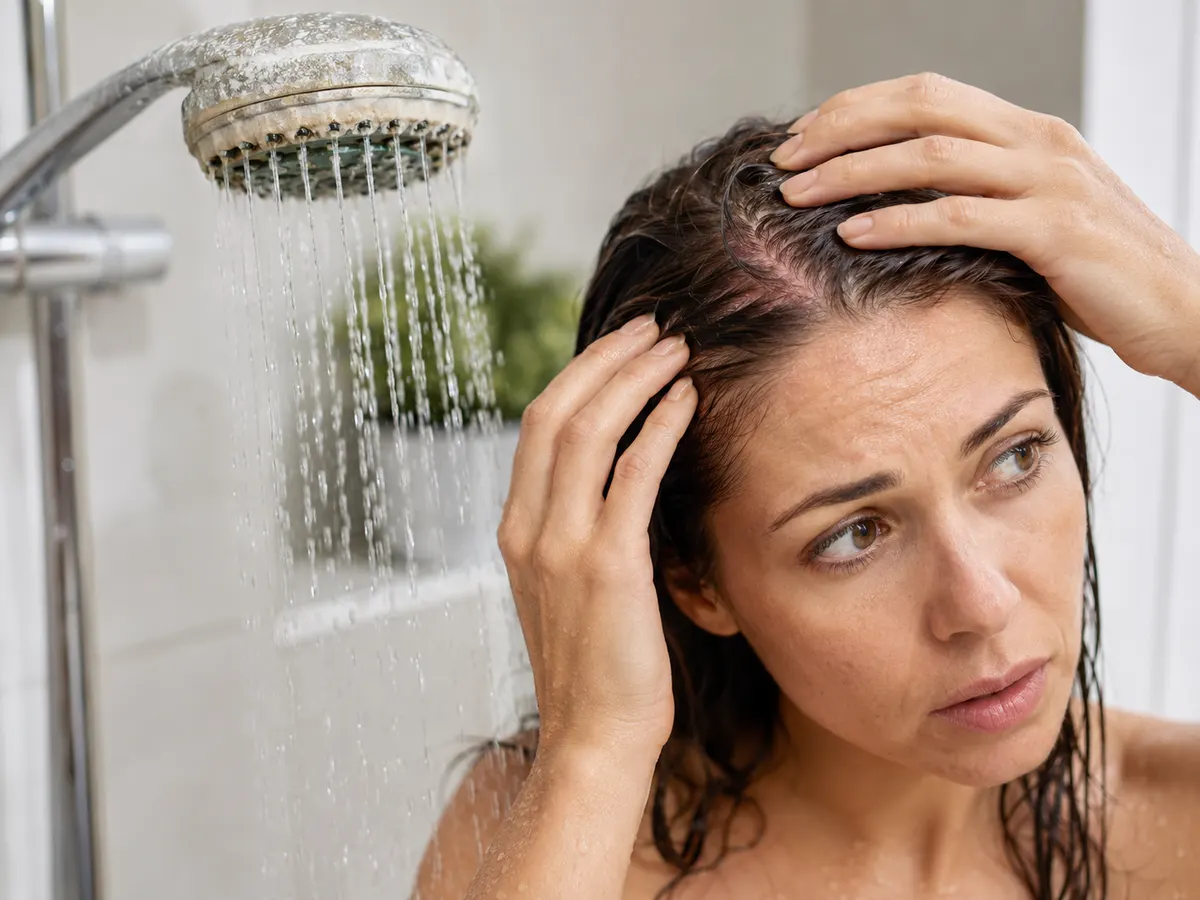
If you’re reading this, you’re probably in Megan’s situation. Itchy scalp after every shower. Rough, dull hair when you haven’t changed a single product. Abnormal breakage when brushing. And the diffuse sense that your bathroom has become a hostile place for your hair.
Here’s what trichology actually knows about hard water causing hair loss — and the concrete fixes that turn an aggressed scalp around in four to six weeks.
Hard water and hair loss: what dermatology won’t tell you clearly
Let’s be clear from line one, because confusion on this topic is massive online. Hard water does not cause alopecia in the strict sense — it does not attack the follicle at its root, doesn’t miniaturize it, doesn’t kill it. Your hair follicles sit under the scalp, protected by the epidermis. Water never reaches them directly.
What it does is more subtle. And infinitely more poorly diagnosed.
Hard water contains high concentrations of calcium, magnesium, sometimes dissolved iron, and — in U.S. municipal tap water — residual chlorine (used for disinfection). These minerals, when they meet a standard shampoo, create what chemists call soap scum — a calcium-soap residue that deposits on three targets:
- The scalp, where it forms an occlusive film that disrupts natural sebum and the follicular microbiome
- The hair shaft, where calcium ions bind to keratin’s negative charges, stiffen it, and cause micro-fractures
- The follicular opening (the ostium), where it slowly accumulates and maintains low-grade inflammation
The clinical result: dry and inflamed scalp (which looks like seborrheic dermatitis but isn’t), weakened fiber that breaks mechanically, and in women already fragile from hormonal or nutritional terrain — existing shedding that worsens by 20 to 40 percent.
💡 Elena S.’s tip: “A patient, Caroline, 41, dentist in Dallas, came to me with massive shedding she blamed on her divorce — which made sense, two grueling years. We ran her bloodwork: ferritin 65, TSH 1.8, vitamin D 42. Everything was good. And the shedding persisted. The breakthrough came when she said: ‘I wash my hair three times a week and every time it’s hell.’ Dallas tap water sits above 180 mg/L CaCO₃. Six weeks after installing a filtering showerhead and starting an apple cider vinegar protocol, her shedding had halved. Not her cortisol — her water.”
The 5 warning signs nobody links to your tap water
These are the five clinical signs I systematically review with my patients when I suspect hard water aggravating their hair loss. In isolation, none is diagnostic. Three out of five, and the diagnosis is almost certain.
1. Itching that starts within an hour after showering
It’s not your skin reacting to shampoo. It’s the soap-scum film settling onto a dry scalp, disrupting its natural pH (4.5–5.5), and triggering a defensive reaction. Itching typically appears 10 to 45 minutes after rinsing — the time it takes for the film to dry and tighten.
2. Dry flakes that appear within days
Not to be confused with the greasy flakes of seborrheic dermatitis (which stick, turn yellow, and itch intensely at night). Hard-water flakes are thin, white, easily dislodged by combing, mostly on the front and sides, and worsen in the days after a wash.
3. Rough, “not clean” hair coming out of the shower
The foolproof test: touch your wet hair right after rinsing. On healthy water, it slides between your fingers. On hard water, you feel a residual film, a “not clean” sensation despite the shampoo. That’s exactly the calcium-soap scum signature.
4. Abnormal breakage when detangling
You pull on the brush and see 2 to 3 cm hair fragments caught in it — not whole hairs with their white telogen bulb, but mid-shaft broken fragments. That’s the hallmark of calcium-induced fiber weakening, which makes the strand brittle where it shouldn’t be.
5. Color fading and “going off-tone” on dyed or highlighted hair
Calcium and iron ions in hard water react with artificial pigments — blonde shifts to brassy yellow, brown loses its reflects, red darkens. If your color doesn’t hold three weeks like it used to, check your water before blaming your colorist.
Water Hardness Test Strips for Home
Colorimetric test strips measuring total hardness in ppm (mg/L CaCO₃) and grains per gallon (gpg) · Result in 5 seconds · 50 tests per pack · Test both kitchen and bathroom (values can differ)
- Measures total hardness + chlorine + pH
- Compare cold vs hot water
- Verify the efficacy of any filter
- Essential before buying any showerhead
$11.99
View on AmazonAffiliate link
Hard water in the U.S.: where you stand on the hardness map
In the U.S., hardness is usually given in ppm (mg/L of CaCO₃) or grains per gallon (gpg). The USGS thresholds I share with my patients:
- 0–60 ppm (0–3.5 gpg) — Soft water, no concern (Seattle, Portland, much of New England coast)
- 61–120 ppm (3.5–7 gpg) — Moderately hard (California, NYC, Chicago, Boston suburbs)
- 121–180 ppm (7–10.5 gpg) — Hard, action recommended (most Midwest cities)
- >180 ppm (>10.5 gpg) — Very hard, filter essential (Phoenix, Las Vegas, Indianapolis, San Antonio, Tampa, much of Florida and Texas)
Roughly 85% of U.S. households receive hard water (>60 ppm) according to USGS data. In the UK, the entire southeast (London, Cambridge, Brighton) sits in very hard zones above 270 ppm, while Scotland and the West of England are largely soft. If you’re in the UK, your odds of hard-water exposure are similar.
The “soft region” trap
Important caveat: the hardness reported by your municipality reflects water delivered at the treatment plant. Limescale can build up in your home pipes over decades, and the hardness you experience at home can run 20–30% higher than the city figure. Always run a test strip at your actual bathroom tap — not just the kitchen, which may have a separate softener.
Interactive test: is your water causing your shedding?
Before buying equipment, take 60 seconds for this test. It’s built from USGS 2024 hardness data by metropolitan area and from trichological criteria for mineral scalp aggression. The result points you to the priority action for your specific case — not a generic recommendation.
Hard water test · 4 questions
Is your shower water causing your hair loss?
Question 1 / 4 · Your area
Where do you live in the U.S. or UK?
💡 Test designed by Elena S. using USGS 2024 water hardness data and trichology literature on mineral aggression of the scalp (Luqman 2013, Aral 2019).
Whatever your score, remember this principle: hard water acts as a cofactor — it accelerates or maintains existing hair loss rather than causing it alone. If your test points to a probable culprit, you’ll capture 30 to 50% of clinical improvement just by fixing this parameter. If your water is soft, look elsewhere — hormonal or nutritional. Our guide on chronic telogen effluvium recovery covers the exact bloodwork to request.
The science: why limescale weakens your hair fiber
This is where we get molecular. Three robust studies have documented this mechanism in the past decade — and the convergence is strong.
Luqman 2013: the first clear demonstration
Luqman and colleagues (International Journal of Trichology, 2013) compared in vitro tensile strength of hair strands exposed for 30 days to distilled water (control), moderately hard water (150 ppm), and very hard water (>300 ppm). Result: strands exposed to very hard water showed a 15% reduction in average thickness and a significant increase in micro-fractures compared to control. Tensile strength wasn’t drastically altered — but visual appearance and breakability, yes.
Aral 2019: the scalp effect
Aral et al. (Journal of Cosmetic Dermatology, 2019) ran a clinical study on 70 women in a hard-water zone (central Turkey), exposed for 6 months to either their tap water or filtered water (KDF + activated carbon system). The “filtered water” group showed significant reduction in itching, dry flakes, and measured sebum via sebumetry. No statistical difference in hair shaft diameter itself — confirming the effect is scalp-driven, not deep-follicle.
The molecular mechanism in three steps
Here’s what biologically happens, in a few lines:
1. Reaction with shampoo. The anionic surfactants in your shampoo (sodium lauryl sulfate, sodium coco-sulfate, even the “gentle” ones) preferentially bind Ca²⁺ and Mg²⁺ ions before they ever reach the sebum they’re meant to clean. Result: the shampoo cleans half as effectively, and precipitates as calcium soap scum that deposits wherever you rinse.
2. Saturation of keratin’s negative charges. Hair keratin is negatively charged (carboxylate groups). Bivalent and very small Ca²⁺ ions slot into the cuticle and cortex structure. This stiffens the fiber, reduces elasticity, and causes longitudinal fractures when it undergoes mechanical tension (brushing, styling, tying up).
3. Disruption of the hydrolipidic film. A healthy scalp maintains an acidic film (pH 4.5–5.5) that regulates the follicular microbiome and limits inflammation. Soap scum is mildly basic (pH 8–9). Every shower pushes scalp pH toward alkaline for several hours — enough to lastingly disorganize flora and sebum, opening the door to Malassezia (seborrheic dermatitis fungi) and low-grade chronic inflammation.
💡 Elena S.’s tip: “I often tell my patients: your scalp is not sick, it’s under attack. The distinction changes everything. A sick scalp needs medical treatment. An attacked scalp needs the attacker removed. Once you change the quality of the water hitting your head, the scalp rebalances itself in 4 to 8 weeks. It does its job. You just have to stop bombarding it.”
Hard water shower filter benefits: what actually works
The filtering showerhead market exploded after 2020 — and not everything is equivalent. Here are the four big categories, with what the literature actually says.
1. Ceramic-bead + KDF showerheads — the best mainstream option
This is the technology I default to. Ceramic beads release negative ions that disaggregate mineral clusters. KDF (Kinetic Degradation Fluxion) — a copper-zinc alloy — neutralizes residual chlorine via a redox reaction and partially precipitates heavy metals (lead, mercury).
What it does well: 80–95% reduction of chlorine, chloramine neutralization, heavy metal filtration, reduction of visible deposits in the shower.
What it doesn’t do miraculously: a showerhead alone does not eliminate all calcium (for that, you’d need an ion-exchange softener). But it ionizes it and makes it less aggressive on the scalp — which is what matters for the fiber.
Price: $25–60. Cartridge lifespan: 6 to 12 months depending on use.
Hard Water Shower Filter — Ceramic Beads + KDF
KDF + ceramic beads + activated carbon technology · Reduces chlorine, hardness, and heavy metals · Compatible with standard hoses · Cartridge to change every 6 to 8 months depending on use
- Chlorine reduction up to 95%
- Ionizes calcium to soften water for hair
- 2-minute install, no plumber needed
- Visible scalp effect from week 1
$39.99
View on AmazonAffiliate link
2. Vitamin C filters — effective but limited
Vitamin C (ascorbic acid) very effectively neutralizes chlorine through a chemical reaction. That’s validated, not marketing. But it has no action on calcium or magnesium — useful only if your primary issue is chlorine (atopic skin, eczema) and not hardness.
3. “Ionizing” or “magnetic” showerheads without certification
Skip them. No published study validates “magnetizing” water to reduce hardness effects on hair. It’s often aggressive marketing at high prices ($80–150). If you see “magnetic field” or “tourmaline” without any mention of KDF or ceramic filtration, walk away.
4. Whole-home water softener (salt-based) — real solution but heavy
A water softener installed at your home’s water intake truly removes calcium (sodium ↔ calcium ion exchange). It’s the most complete, scientifically validated solution — but it costs $800–3000 installed, requires regular maintenance (salt refills), and adds sodium to your cooking water (not recommended for infants and hypertensives). Worth considering if you own your home and live in a very hard zone (>180 ppm).
The 30-day protocol to repair a hard-water aggressed scalp
Once the diagnosis is set and the filtering showerhead installed, here’s the routine I systematically structure with my patients for the recovery phase. Four weeks, four steps — and a measurable result in 80% of cases.
Week 1 — Install and corrective final rinse
First reflex: install your filter on day 1. During week 1, add a systematic final rinse with filtered bottled water (or filtered rainwater) — 500 mL is enough to wash off the last veil of residual minerals from the fiber. Pour slowly from the nape to the tips, without rubbing.
It looks like a tiny gesture. It isn’t. On hard water, the final rinse deposits the most scum, because there’s no surfactant left to solubilize it.
Week 2 — Clarifying chelating shampoo once a week
To detach deposits accumulated over months, a clarifying shampoo with chelating action (containing EDTA or sodium phytate) is essential once a week. It releases the calcium ions trapped in keratin and restores fiber suppleness.
Caution: no more than once a week, and especially not on color-treated hair without precaution — it also removes part of the artificial pigments. The other days, return to your usual gentle shampoo.
Clarifying Chelating Shampoo for Hard Water
Formula with EDTA / sodium phytate · Detaches mineral deposits accumulated on hair and scalp · Use once a week maximum · No harsh sulfates
- Releases calcium and iron bound to keratin
- Restores suppleness in 1 use
- Compatible with gentle daily routine
- Ideal for water >120 ppm
$18.99
View on AmazonAffiliate link
Week 3 — Weekly apple cider vinegar rinse
The gold-standard gesture for rebalancing scalp pH. Dilute 1 tablespoon organic raw apple cider vinegar (unpasteurized, with the mother) in 250 mL filtered water, pour over the entire scalp after shampoo, massage 30 seconds, rinse with filtered water.
The mechanism is documented: acetic acid solubilizes calcium residues bound to keratin, the acidic pH (4.5) reseals the cuticle, and the organic acids in the vinegar “mother” deliver a mild anti-inflammatory effect on the scalp. Once or twice a week, no more.
Organic Apple Cider Vinegar Raw with the Mother
Organic unfiltered apple cider vinegar containing the living mother · 5% acidity · Restores scalp acidic pH and solubilizes calcium deposits · 1 tablespoon per 250 mL of water
- Solubilizes calcium bound to keratin
- Reseals the cuticle (instant shine)
- Organic acids with anti-inflammatory action
- 1 to 2 rinses per week maximum
$12.99
View on AmazonAffiliate link
Week 4 — Hydrolipidic film restoration
This is the phase almost everyone skips, and the one that makes long-term difference. A scalp that’s been exposed to hard water for months has lost its protective film. To restore it, jojoba oil massage — the closest structural analog to human sebum — two evenings a week on dry scalp, 15 minutes before shampoo.
Jojoba oil doesn’t nourish like a classic mask. It mimics the missing sebum and lets the scalp relearn to regulate itself. Visible effect: less tightness after shower, fewer dry flakes, and a gradual return of natural shine on the lengths.
Organic Cold-Pressed Jojoba Oil
100% pure organic cold-pressed jojoba oil · Structure identical to human sebum · Ideal for restoring the hydrolipidic film of a hard-water aggressed scalp · Suitable for all hair types
- Same structure as human sebum
- Regulates natural sebum production
- Non-comedogenic, not greasy after rinse
- Massage 2 evenings/week 15 min before shampoo
$15.99
View on AmazonAffiliate link
Bonus: the two night habits that consolidate everything
Don’t underestimate the mechanical impact at night on hair that’s already taken hard water hits all day. Two simple habits each night consolidate the protocol’s work:
- 22-momme silk pillowcase: eliminates the friction that amplifies breakage on calcium-fragilized fiber
- Soft silicone brush: for scalp massage under jojoba oil, with no risk of micro-trauma
💡 Elena S.’s tip: “Megan, the Phoenix patient from the start, came back at six weeks of protocol. She put her phone on the desk and showed me two photos one month apart in the same bathroom light. Before: thinning part, dull lengths, flat roots. After: visibly recovered density, restored shine, and — her words — ‘the first time in five years I can touch my wet hair without wincing.’ We didn’t change a thing in her diet, her sleep, her hormones. We changed her water. And that was enough.”
FAQ — Your questions on hard water and hair loss
Can hard water really cause hair loss?
Not a true alopecia in the sense of follicular destruction. Hard water doesn’t pull hair out at the root. But it systematically aggravates every existing shedding pattern through three mechanisms: mechanical breakage of fragilized fiber, chronic scalp inflammation, and disruption of the follicular microbiome. In a woman already in telogen effluvium, moving to a very hard water zone can amplify visible shedding by 20 to 40 percent. In a woman with stable hair terrain, hard water mostly creates breakage and a dry scalp.
How do I precisely know my water’s hardness?
Three methods, in increasing reliability. Method 1: check the USGS National Water Quality map or your local water utility’s annual report — hardness is published. Method 2: use colorimetric test strips ($10–15 at hardware stores or Amazon) — result in 5 seconds. Method 3: buy a digital TDS meter ($15–25) measuring total dissolved solids in ppm — direct correlation with hardness. Test at your shower tap, not just the kitchen (values can differ).
Are the benefits of a shower filter really enough for hair loss?
For most cases, yes — provided you understand what it does. A ceramic-bead + KDF filtering showerhead ionizes calcium and neutralizes chlorine, which is enough to suppress 80% of the scalp and fiber aggression. You won’t get fully “softened water” like with a whole-home softener, but you’ll get functionally softer water for hair. The big difference shows up within week 1 on itching, and by month 1 on breakage.
Does apple cider vinegar damage color-treated hair?
No, provided you dilute it properly (1 tablespoon per minimum 250 mL water) and don’t exceed two rinses a week. Quite the opposite: on color-treated hair in hard water zones, apple cider vinegar reseals the cuticle opened by minerals and often makes color last longer. Just avoid it on plant-based dyes (henna), which can react with acidity, and patch-test a hidden strand the first time.
How long before I see a difference?
Typical timeline I see in clinic: week 1, disappearance of post-shower itching and the “residual film” sensation; weeks 2–3, visible reduction in detangling breakage, shine coming back; weeks 4–6, density felt on touch increases, dry flakes vanish; month 3, measurable gain on photos (visual density, intact lengths). If you see no improvement after 6 weeks of strict protocol, your water isn’t the main culprit — re-take the interactive test above to reorient the diagnosis.
Does my solid bar shampoo / no-poo / Castile soap protect from limescale?
Quite the opposite, it’s often a trap. Solid bar shampoos and traditional soaps (Castile, Aleppo, Marseille) are based on saponified fatty soaps that react massively with hard-water calcium — that’s exactly the soap scum we’ve been discussing. On water above 150 ppm, a solid bar shampoo often deposits more scum than a modern liquid shampoo, and accelerates the “not clean” feel. If you’re committed to your zero-waste routine, a filtering showerhead becomes non-negotiable.
Sources and Clinical Studies
-
Luqman MW, Ramzan MH, Javaid U, et al. — To compare the effects of hard and soft water on the tensile strength of hair, Int J Trichology, 2013; 5(3): 149–153. PubMed
-
Aral A, Aral AM, Mert E, et al. — Effect of hard water on hair: a clinical study on female volunteers, J Cosmet Dermatol, 2019; 18(3): 824–828. PubMed
-
Punnonen R. — Bathing trihalomethanes and the hair shaft, Acta Derm Venereol, 1991; 71(5): 449–451. PubMed
-
Tanus A, Oliveira CC, Villarreal DJ, et al. — Black women’s hair: the main scalp dermatoses and aesthetic practices, An Bras Dermatol, 2015; 90(4): 450–465. PubMed
-
U.S. Geological Survey (USGS). — Map of water hardness in the United States, 2024 update. Official source
Medically reviewed by our in-house committee of dermatology experts. This article is informational and does not replace a medical consultation. If your hair loss persists after 8 to 12 weeks of filtered-water protocol, consult a dermatologist specialized in trichology to investigate other potential causes (hormonal, nutritional, genetic).